
Analog Origins. Digital Precision.
The Madison Phono brings Wattson Audio’s high-density engineering philosophy to vinyl playback. Developed from design principles proven at the highest level of CH Precision engineering, it rethinks the phono stage for modern systems while preserving the immediacy, texture, and musical presence that make analog replay so compelling.

The Madison Phono is available with three input-stage architectures, each designed around the specific electrical behavior of the cartridge or transducer it serves. Rather than treating cartridge compatibility as a matter of gain and loading alone, each version addresses the fundamental way signal is generated, transferred, and converted at the input. Moving magnet, moving coil, and DS Audio photo-electric cartridges impose different requirements; the Madison Phono responds with dedicated circuitry for each.

Engineered for the Source
The Madison Phono accommodates both moving magnet and moving coil cartridges, with dedicated input stages for voltage and current operation.
The voltage-input version supports MM and high-impedance MC cartridges through a two-stage amplification circuit with automatic gain and loading, simplifying setup while preserving the cartridge’s natural dynamic behavior.
The current-input version is designed for low-impedance MC cartridges. Derived from CH Precision technology and unique to Wattson Audio, it replaces the simple passive current-to-voltage conversion found in most phono stages with a true active transimpedance amplifier. This reduces sensitivity to cable characteristics, loading interactions, and impedance variation, preserving frequency response, transient precision, and background quietness.
Optical Replay, Redefined
For DS Audio photoelectric cartridges, the Madison Phono uses a dedicated optical input stage operating in photoconductive mode, built around a true active transimpedance circuit designed specifically for optical cartridge replay.
For DS Audio photoelectric cartridges, the Madison Phono uses a dedicated input stage operating in photoconductive mode, built around a true active transimpedance amplifier designed specifically for optical cartridge replay.
Unlike the common voltage approach seen in many designs, this active circuit drastically improves dynamic performance. Frequency response remains more stable, transients are preserved with greater precision, and the noise floor stays lower—allowing the cartridge’s speed, clarity, and low-level information to emerge.


Historic Curves. Modern Precision.
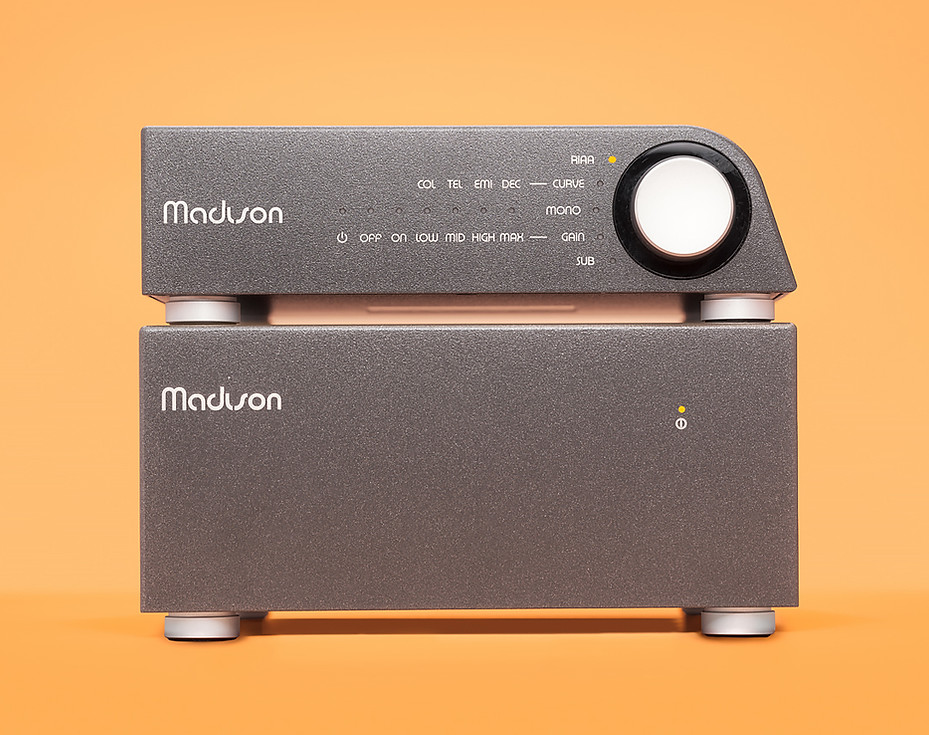
In the Madison Phono, equalization is removed from the analog signal path. The cartridge signal is amplified through a fully linear analog stage, then digitized at 32-bit / 384 kHz—DXD mastering-studio quality and far beyond the practical limits of vinyl playback.
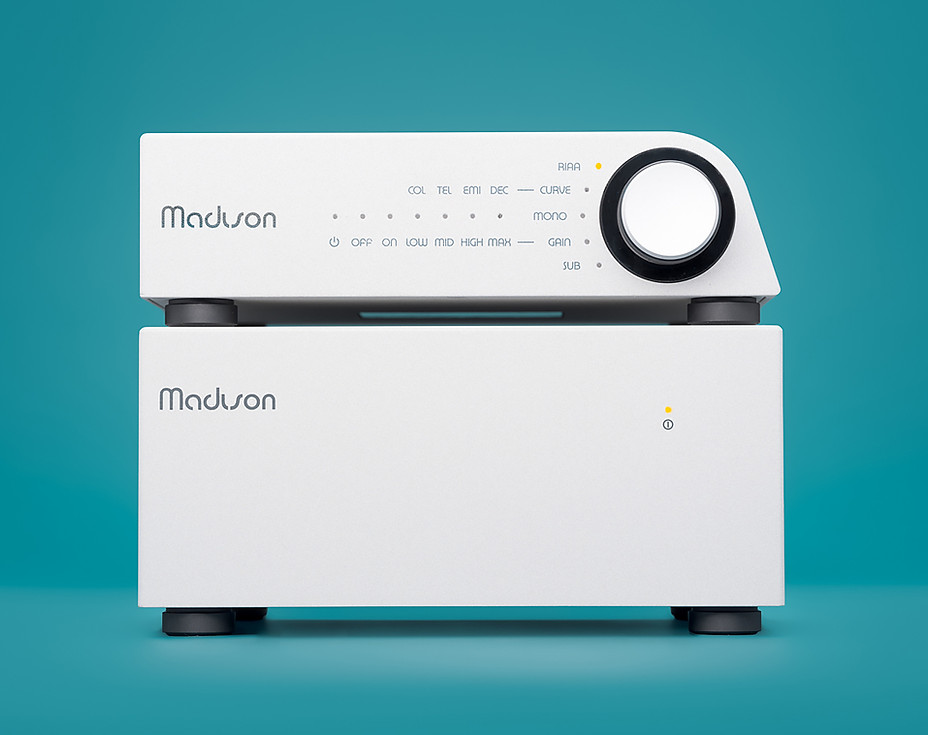
Correction curves and filtering are then handled in the digital domain, where they can be implemented with exceptional precision, repeatability, and flexibility. Freed from analog equalization networks, switch contacts, and large passive components, the amplification circuitry remains simpler, cleaner, and more stable. RIAA, Columbia, Teldec, EMI, and Decca curves can be applied with ±0.1 dB accuracy, allowing records mastered under different historical standards to be replayed with the correct tonal balance.
Built for the Modern High-End System
The Madison Phono is designed to integrate naturally into both traditional analog systems and contemporary DAC-centered architectures. Stereo analog RCA outputs allow direct connection to a preamplifier or integrated amplifier, while coaxial and optical S/PDIF outputs allow the Madison Phono to feed a Madison Streamer or a third-party external DAC.
This dual-output architecture gives Madison Phono unusual flexibility. Vinyl replay can remain central in a purist analog system, become part of a coherent Madison-based system, or integrate seamlessly into a system built around digital conversion and streaming.

Compact Form, Swiss Engineering
The Madison Phono follows the same physical discipline as the rest of the Madison line: circuits stripped down, miniaturized, and integrated into dense boards within a compact enclosure milled from solid aluminum. The chassis provides electromagnetic shielding, mechanical rigidity, and a non-resonant foundation for sensitive circuitry.
Network connectivity supports firmware updates and remote control. Software and hardware are treated as parts of the same long-term design strategy, while the three input-stage modules can be exchanged at a later date as cartridge requirements or system priorities change.

A Quieter Foundation
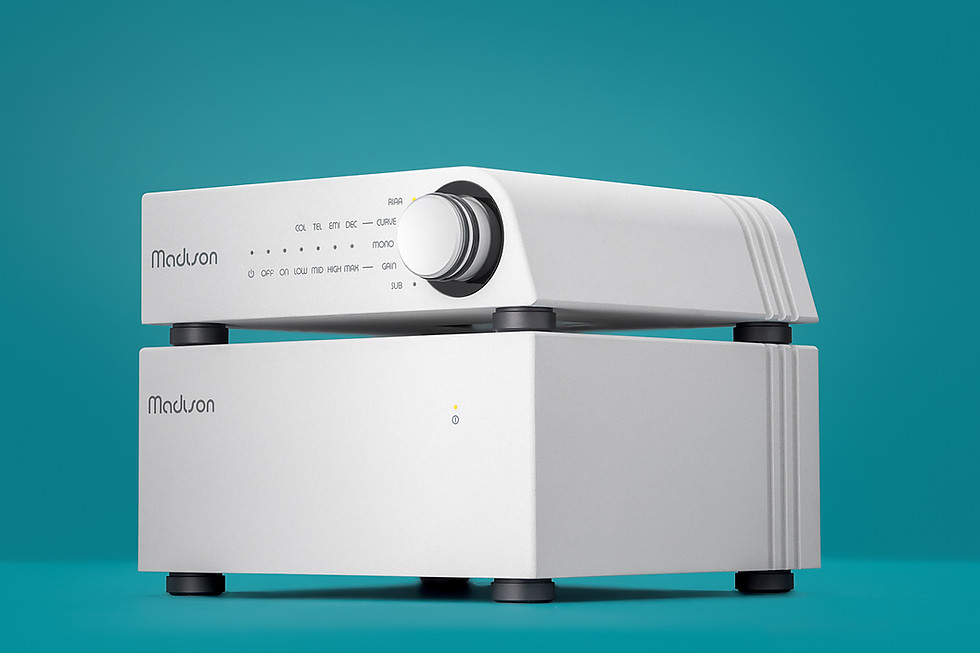
The Madison Phono operates at the most delicate point in the analog chain, where minute cartridge signals must be amplified, equalized, and converted without adding noise or obscuring musical information. Adding the Madison PowerS gives this critical circuitry a cleaner, quieter, and more stable electrical foundation.
Its purpose-built architecture lowers the noise floor and improves supply stability, allowing low-level detail, spatial information, and harmonic texture to emerge with greater clarity. Transients become more precise, the soundstage becomes more stable, and music develops from a quieter, more composed background.
For the Madison Phono, the PowerS provides the quality of supply this level of signal demands: clean, stable, low-noise power that helps preserve the full expressive character of vinyl playback.


A Madison Phono Stage
Vinyl playback begins with a fragile signal. Madison Phono protects that signal through dedicated analog input architectures, converts it with studio-grade precision, and applies equalization in the digital domain with accuracy that conventional compact analog circuits cannot match.
It is a phono stage shaped by Wattson’s defining priorities: simplicity without simplification, compactness without compromise, and technology placed entirely in service of musical engagement.
From MM and MC cartridges to DS Audio optical transducers, from digital output to analog connectivity, Madison Phono brings vinyl into the Madison system with clarity, flexibility, and structural purpose.
The Madison Phono User Manual
Each Wattson Audio product is independently tested under the IECEE CB Certification, confirming compliance with internationally recognized electrical-safety standards and the national requirements of major markets worldwide. Including the certificates makes Wattson’s engineering accountability visible: performance is supported by documented testing, regulatory rigor, and readiness for global distribution.
Specifications
General
-
Type: Phonostage
-
Color: Light gray or dark grey
-
Dimensions (W x D x H): 175 x 185 x 52 mm
-
Weight: 1.7 kg
-
Power Supply: External 5 V DC, 18 W, universal AC input
-
Power consumption: < 0.5 W standby, 4.0 W nominal
User interface
-
Curve, Mono, Gain, Subsonic, standby / ON
-
Remote control: Via Ethernet connection
-
Firmware update: Via Ethernet connection
Analog input (voltage sensing input for MM/MC cartridges)
-
Type: RCA single-ended
-
Impedance: 47 kΩ for MM, 470 Ω or 100 Ω for MC, user selectable
-
Gain: +34 dB and +40 dB for MM, +54 dB and +60 dB for MC, user selectable
-
Equivalent Input Noise (A-weighted): -134 dBu / 10 Ω termination
Analog input (Current sensing inputs for MC cartridges)
-
Type: RCA single-ended
-
Impedance: < 1 Ω, virtual ground
-
Gain: +48 dB to +66 dB in 6 dB steps (10 Ω cartridge internal impedance)
-
Equivalent Input Noise (A-weighted): -139 dBu / 10 Ω termination
Optical input (Current sensing inputs for MC cartridges)
-
Type: Optical/current sensing inputs for DS Audio optical cartridges
-
Impedance: < 1 Ω, virtual ground
-
Gain: +58 dB to +76 dB in 6 dB steps
-
Equivalent Input Noise (A-weighted): -128 dBu / 10 Ω termination
A/D conversion and processing
-
Conversion Type: DXD 32bit / 384kHz
-
Equalization Processing Resolution: 32bit / 384kHz
-
EQ curves available: RIAA, Columbia, Teldec, EMI, Decca
-
EQ curve accuracy: +/- 0.1 dB
-
Subsonic filter: 2nd order at 15Hz, user selectable
Digital outputs
-
Type: RCA coaxial S/PDIF, TOSLINK optical S/PDIF
-
Output level: S/PDIF : 500 mVpp, 75Ω, with isolation transformer
-
Sampling rate: 192kHz, user selectable down-sampling to 96kHz
Analog outputs
-
Type: RCA Single-ended
-
Conversion type: Multi-bit Sigma-Delta, chip-based
-
Output level (full scale): 2.0 V RMS
-
Total Harmonic Distortion + Noise (full scale): < 0.001 %
-
Signal-to-noise ratio (A-weighted): > 120 dB